Human Rights, Power and Civic Action: Comparative Analyses of Struggles for Rights in Developing Societies by Bård A. Andreassen & Gordon Crawford
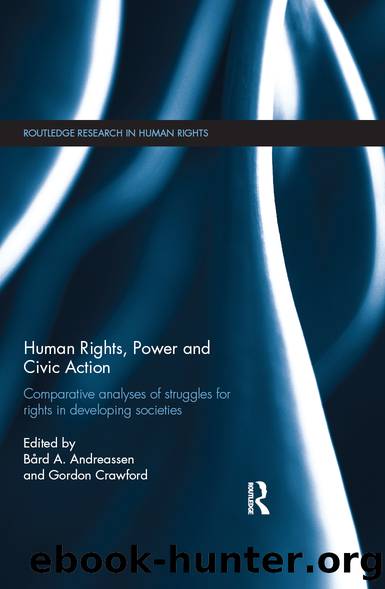
Author:Bård A. Andreassen & Gordon Crawford [Andreassen, Bård A. & Crawford, Gordon]
Language: eng
Format: epub
Tags: Political Science, Civil Rights, Comparative Politics
ISBN: 9781138830455
Google: SLrRoAEACAAJ
Barnesnoble:
Goodreads: 23318442
Publisher: Routledge
Published: 2013-04-17T00:00:00+00:00
5 Challenging power
This section concentrates on the challenges to power structures by the different rights-promoting organizations and how they have sought to build countervailing power. Each is taken in turn.
Nkuzi
Nkuzi has shifted from being an organization that attempted to work with the government in order to implement land rights and workersâ rights to an organization in opposition or conflict with its former ally, the government. In its first five years, from 1997 to 2002, Nkuzi sought to work with communities that had land claims to help them bring these claims to the Regional Land Claims Commissioner (RLCC). This space was partly open and invited and partly claimed, since these were new areas for both the government and Nkuzi. However, Nkuzi was working from the premises of what the government wanted to achieve. It also pressured the RLCC to open an office in Polokwane Pietersburg rather than one in Pretoria, which was too far away from the claimants. Nkuzi also campaigned for the application deadline to be pushed forward by several months to the end of 1998, so that communities could submit their claims on time. In terms of its support for farm workers, initially originating from the strike at Tshipise, the space was likewise open and claimed. As new black police officers began to enforce the law impartially instead of just following the wishes or dictates of white landowners, the balance of power shifted and Nkuzi was no longer seen as an enemy by the police.
However, these spaces gradually began to close. This is accounted for by two factors. The first was the slow progress of land reform, be it tenure reform, restitution or redistribution, which made the government highly defensive of its policies and processes. The second was the emergence of the LPM, which actively promoted land occupations and opposed the governmentâs reliance upon the model of willing buyer/seller. In 2002, the LPM promoted the âWeek of the Landlessâ, with a march in Johannesburg during the week before the World Summit on Sustainable Development. The government already viewed the LPM as a threat and attempted to block the march, making this is an instance of visible power by the government. In addition, the LPM was subject to National Intelligence Agency harassment (Duncan, 2003: 13). It was hoped that this march, under the banner of Social Movements Indaba (SMI), which mobilized up to 25,000 people, would lead to a new era in South African politics (Malan, 2002). Yet, as this chapter demonstrates, it did not.
Land NGOs had operated in claimed and invited spaces when they supported or supplemented government land policies. But in 2000, with the replacement of the Settlement Land Acquisition Grant (SLAG) by Land Redistribution for Agricultural Development (LRAD), Nkuzi and other land NGOs found themselves in opposition to the shift in land reform strategies. A SLAG grant of 16,000 rand per person was provided to poor and black South Africans who formed groups to buy and develop farmland. The applications took the form of group settlement with
Download
This site does not store any files on its server. We only index and link to content provided by other sites. Please contact the content providers to delete copyright contents if any and email us, we'll remove relevant links or contents immediately.
| Anthropology | Archaeology |
| Philosophy | Politics & Government |
| Social Sciences | Sociology |
| Women's Studies |
The Secret History by Donna Tartt(19088)
The Social Justice Warrior Handbook by Lisa De Pasquale(12190)
Thirteen Reasons Why by Jay Asher(8909)
This Is How You Lose Her by Junot Diaz(6887)
Weapons of Math Destruction by Cathy O'Neil(6279)
Zero to One by Peter Thiel(5802)
Beartown by Fredrik Backman(5754)
The Myth of the Strong Leader by Archie Brown(5507)
The Fire Next Time by James Baldwin(5445)
How Democracies Die by Steven Levitsky & Daniel Ziblatt(5218)
Promise Me, Dad by Joe Biden(5153)
Stone's Rules by Roger Stone(5088)
A Higher Loyalty: Truth, Lies, and Leadership by James Comey(4964)
100 Deadly Skills by Clint Emerson(4925)
Rise and Kill First by Ronen Bergman(4789)
Secrecy World by Jake Bernstein(4753)
The David Icke Guide to the Global Conspiracy (and how to end it) by David Icke(4719)
The Farm by Tom Rob Smith(4509)
The Doomsday Machine by Daniel Ellsberg(4490)
